Visar inlägg med etikett appliances. Visa alla inlägg

måndag 19 december 2011

Overjet, surgery and braces - alternatives

I’ve read a lot on blogs and forums lately about people who are about to undergo surgery for their overjet. First and foremost I wonder why they didn’t get treatment earlier (around age seven) but that’s a topic for another blog post. Something that seems very common is to wear braces for overjet for a very long time, usually with rubber bands, after which the orthodontist gives up and says, “nope, this didn’t do anything, you’re going to need surgery”.
Functional orthodontists, however, claim that an overjet can’t be corrected with braces alone (and certainly not combined with tooth extractions) so according to them that would be a waste of time. In cases when traditional orthodontists believe they have solved the problem, they have instead created an illusion and an even worse functional problem has been produced.
You could die trying to move the teeth around in order to take care of an overjet but it’s not going to help since it’s a skeletal issue. The teeth are not to blame and should be taken out of the equation.
This is why I am an advocate for functional orthodontics. Read here what my guru Tooth975, a functional orthodontist who works for Yahoo Answers, says about this matter.
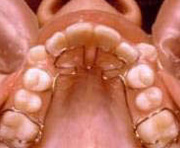
ALF, Crozat and Schwarz are all examples of functional appliances that are used to broaden the upper arch in both adults and children. They are sometimes also used to expand the upper jaw forward. The lower jaw can be brought forward by using a splint. Please note that these appliances don’t move the teeth but instead they focus on the jaws which is the right way to go! You might need braces afterwards but this final touch usually doesn’t take too long.
Here, Tooth975 explains how the lower jaw has to be guided forward by stretching the muscles. This may sound strange to somebody who hasn’t dealt with these problems themselves. The best way to explain this is that the lower jaw can sometimes “hang” too far back even though there is enough bone for a non surgical approach to work.
Furthermore, Tooth975 (I know, gotta love him, right?!) says that surgery should always be avoided if possible. Sometimes it’s necessary of course but in most cases the problem could also have been prevented if it had been dealt with at an early age.
It seems relevant to discuss if too many people are recommended to have surgery. If the only alternative presented is extraction/retraction orthodontics that only camouflages the problem and doesn’t solve it, this is a very serious matter. Recovery time after surgery is several months and there is always the risk of loss of sensation in the lower lip. Some patients lose a lot of weight because they can’t eat normally for a while. Not to mention the physical and emotional suffering involved. However, here in Sweden, this is what the county council and national health insurance are willing to cover.

lördag 6 augusti 2011

Types of orthodontic appliances

I have read more about orthodontics than is healthy for the brain. Slowly an opinion began to take shape, an opinion that is based on something I've felt all along: "Why only consider the teeth, that they need to be straight, if they don't fit the face, if the face loses its shape, if the profile is damaged?" And: "Why defy the body, nature itself, when it's the most brilliant machine that exists? Why torture people for years with uncomfortable and sometimes horrible appliances?"

These thoughts make me very upset, especially at this age because I've started thinking, "What if I get kids, how do I deal with these things? I can't make it go through just anything." But now I know everything worth knowing about new findings and that it doesn't have to be this way. You don't need to wear the worst appliances available for it to work. The less bulky ones usually work better because they take advantage of the body. It really makes a lot of sense! The body wants to change, to correct itself, but only if it's done in the right way. Furthermore, you don't have to choose between straight teeth and face/function because the good techniques improve the facial appearance and the mouth!

ALF or RPE - which would you prefer? Do you believe me when I tell you that the thin, discreet thing to the left solves more problems?

First and foremost, to not take the entire head and the shape of the jaws into account is often pointless. That's not the way to solve a problem. For years I have been telling myself, "Wow, people who used to wear braces sure have flat faces! And narrow smiles!" and now I realize that I wasn't the only one having these thoughts even though for the longest time I thought I was.

Though bothering too much about the cosmetic part isn't necessary because it comes as a bonus along with all the other advantages with functional orthodontics (functional appliances and braces for adults) and orthotropics (facial growth guidance for kids). TMJ problems, headaches, neck pain and sleep apnea are all serious things, (in my opinion far more serious than wearing out a tooth or two which are often the argument for orthodontic treatment). They are all things you want to avoid. The aesthetic part is related to them though since we humans tend to be able to judge from the appearance of a person if they are healthy or not. Someone who has their chin very close to their neck probably has breathing difficulties. To make the mouth smaller and pushing everything backwards doesn't solve any problems, it makes everything worse.

To guide the growth of the face isn't synonymous with torturing people. In most cases there is no retraction involved. The facial profile should be convex. It improves the airway (trust me, I know all too well what it's like not to be able to breathe properly). The whole purpose is to help the body become as it would have been had it grown correctly.

If I had to make a choice on my child's behalf between crooked teeth or moving everything backwards I would pick crooked teeth any day. As far as I'm concerned, health and a beautiful face are more important than straight teeth. Luckily there are methods where you don't have to choose. Sadly, they're not very commonly used.


Q7RBCNEQGU52